
Part 1 of a Three-Part Series on AI Governance for Nonprofits
Yes. If your staff use AI tools at all, your nonprofit needs an AI use policy, and most organizations still don’t have one. A good policy protects client data and sets clear expectations, so your team can use AI openly instead of in secret. It’s a short, practical document, not a months-long project.
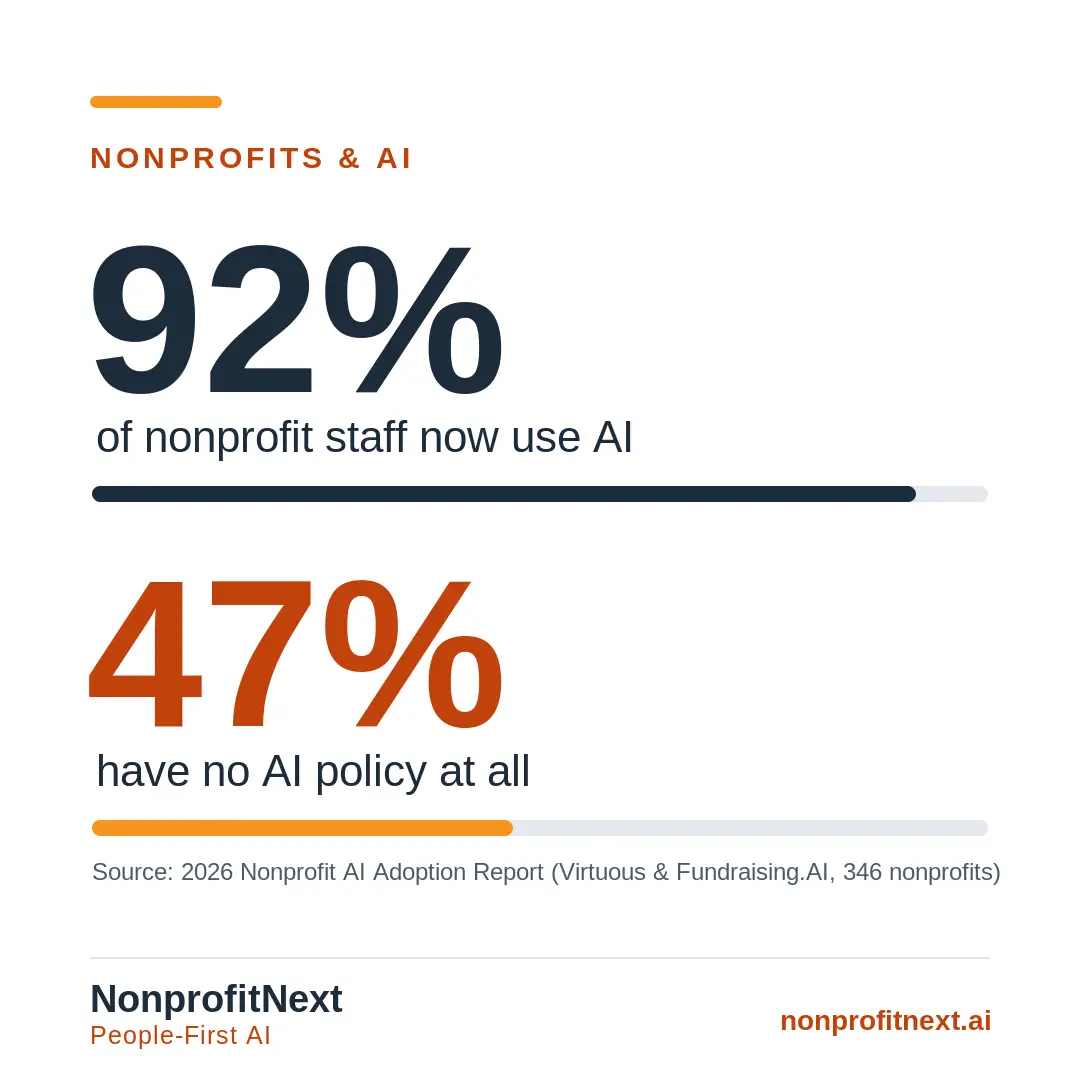
Nearly half of all nonprofit organizations have no AI governance policy. That number comes from the 2026 Nonprofit AI Adoption Report, a benchmark study of 346 organizations published this past February by Virtuous and Fundraising.AI. Both organizations have a commercial interest in the nonprofit technology space, but their findings are consistent with broader sector research. That gap reflects where most organizations are right now.
The same report found that 92% of nonprofits are already using AI in some form. Most of that use is happening without shared guidelines, approved tools, or any organizational awareness of what staff are actually doing. Sixty-five percent of organizations describe their AI activity as reactive and individual. Someone hears about a tool and they try it. They keep using it while leadership may have no idea what information is being shared, with whom, or under what terms.
A Trust Issue at the Core
Nonprofit organizations handle some of the most sensitive personal information imaginable. People share that information with your staff because they need help and because they trust your organization.
When a staff member pastes client details into an AI tool to help draft a case note, they are likely not thinking about data privacy if your organization has not gotten ahead of this issue. The organization now has sensitive information moving through a system it has not reviewed, has no agreement with, and may not even know exists. The client almost certainly has no idea.
That is a breach of trust, even when it is unintentional. In many cases it may also be a compliance violation. Most nonprofits receive funding from government or private sources that carry explicit requirements around data. A staff member’s well-meaning use of an unsanctioned AI tool may quietly put your organization out of compliance with the very funders keeping your programs alive.
What Comes Next
Part 2 of this series will examine the broader ethical and organizational issues, including your transparency obligations to funders and donors, the environmental footprint of AI tools, and the impact on artists and creative workers whose work trained these systems. The reasons to build a policy go further than most people initially expect.
Ready to close the gap at your own organization? Our complete nonprofit AI policy guide walks through writing your first policy in an afternoon, with a free one-page starter template.
Larry is the co-founder and Principal Innovation Strategist at NonprofitNext. Learn more at nonprofitnext.ai.