
The risks of AI for nonprofits go well beyond wrong answers or even the exposure of client data. You also owe transparency to the people you serve, the tools you choose carry an ethical footprint, and AI can introduce bias into decisions about real people or quietly wear down your staff’s judgment. For work that is built on trust, these are not small concerns.
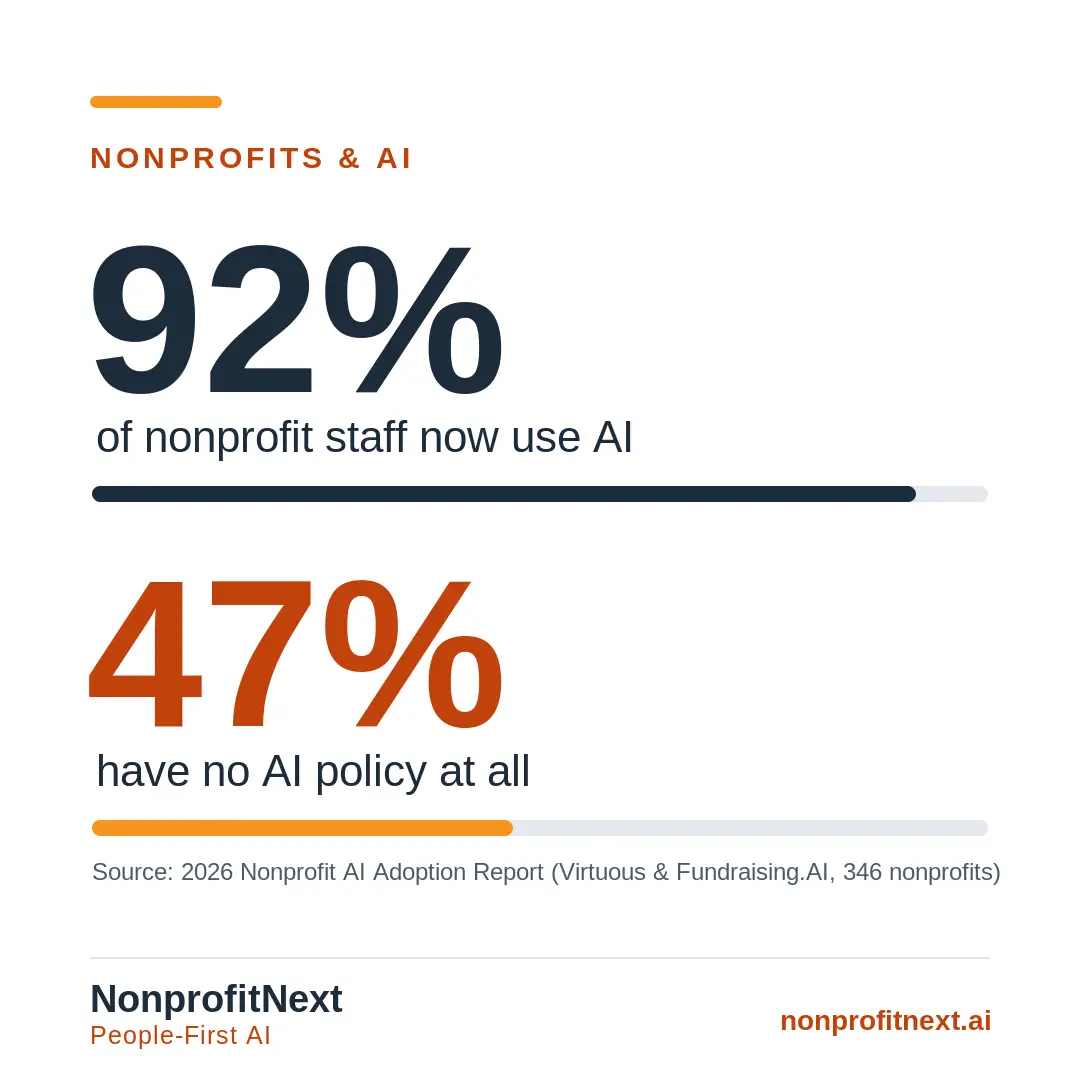
In Part 1 of this series, we looked at the data behind nonprofit AI adoption and the trust issues that arise when sensitive client information enters AI systems without organizational guidance. That is a serious risk, and it is the one most people think of first when the topic of AI policy comes up. The case for a policy, however, goes well beyond your client data.
The Transparency Obligation
Consider how your organization communicates with the people who fund it. A growing number of foundations and government grants are beginning to ask whether AI was used in the preparation of proposals and reports, while others have already adopted formal disclosure requirements. Funders are also asking if and how your organization uses AI elsewhere. Individual donors may ask similar questions, particularly those who care about transparency and want to know that the organization they support is operating with integrity.
Nonprofits are built on relationships of trust with funders, partners, and the communities they serve. A commitment to transparency is not just good practice. It is core to who they are. An AI use policy gives your staff clear guidance on when and how to disclose AI use, so the organization’s communication reflects its values rather than leaving individual staff members to make judgment calls on their own.
Environmental and Ethical Considerations
AI tools, particularly large language models behind tools like ChatGPT, consume significant amounts of energy and water. When an organization’s mission is connected to environmental justice, sustainability, or community wellbeing, there is a real question about whether the tools being adopted are consistent with the values being advanced. That does not mean avoiding AI entirely. It means making deliberate choices and being honest about the tradeoffs.
AI image generators and design tools are increasingly used to produce graphics, illustrations, and visual content, often at little or no cost. What tends to get less attention is that many of these tools were trained on the work of artists, photographers, and illustrators without their knowledge or compensation. For nonprofits that celebrate community, center equity, or work alongside creative industries, using AI-generated imagery is a decision to make deliberately rather than by default.
The Liability Is Real
When AI is used without guidance, the organization is still responsible for what comes out of it. A program report drafted with AI assistance and sent to a funder without careful review. A community outreach message generated by a tool that reflects bias in its outputs. A summary of a client’s situation that contains an error because the staff member assumed the AI got it right. None of these scenarios involve bad intentions. They require only the absence of a clear policy and the expectation of human review. Right now, many organizations have neither.
Why Policies Get Skipped
Most nonprofit leaders are not ignoring this issue out of carelessness. They are stretched thin, managing competing priorities, and often unsure where to begin. AI may also seem like a distant concept that does not yet touch their day-to-day work. A good AI use policy does not require a technology background. It requires clarity about your values, your obligations to the people you serve, and the basic conditions under which AI tools can be used responsibly.
The organizations getting the most out of AI have done this foundational work. They have moved beyond individual experimentation and established AI policy and governance.
What Comes Next
Part 3 of this series gets practical. We will walk through what a nonprofit AI use policy should address and the questions nonprofit leaders need to answer, written in plain language. If you would rather not wait, our complete nonprofit AI policy guide covers what a policy should contain and how to write the first version in an afternoon.
Larry is the co-founder and Principal Innovation Strategist at NonprofitNext. Learn more at nonprofitnext.ai.