
The AI Companies Are Talking About the Safety Net. Nonprofits Should Be in That Conversation.
Last week, OpenAI released a policy document titled “Industrial Policy for the Intelligence Age: Ideas to Keep People First.” If you work in the nonprofit sector, it is worth a close read.
The document calls for a public wealth fund to share AI’s economic gains more broadly, fast-response safety net programs to support workers who lose jobs to automation, and investment in job training to help people find their footing as industries change. The document also calls for major investment in the electrical grid to power all of this technology. That will affect communities too, particularly those that host large data centers or deal with rising energy costs. But for this post, we are focusing on the workforce and safety net pieces, because that is where nonprofits are most directly positioned to act.
What “People-First AI” Means For The People You Serve
Every nonprofit organization exists because someone, somewhere, needs support that they are struggling to provide for themselves. A family navigating a housing crisis. A young person who needs a mentor. An individual living with a disability. A community working to recover from something.
What “People-First AI” Means For Your Staff
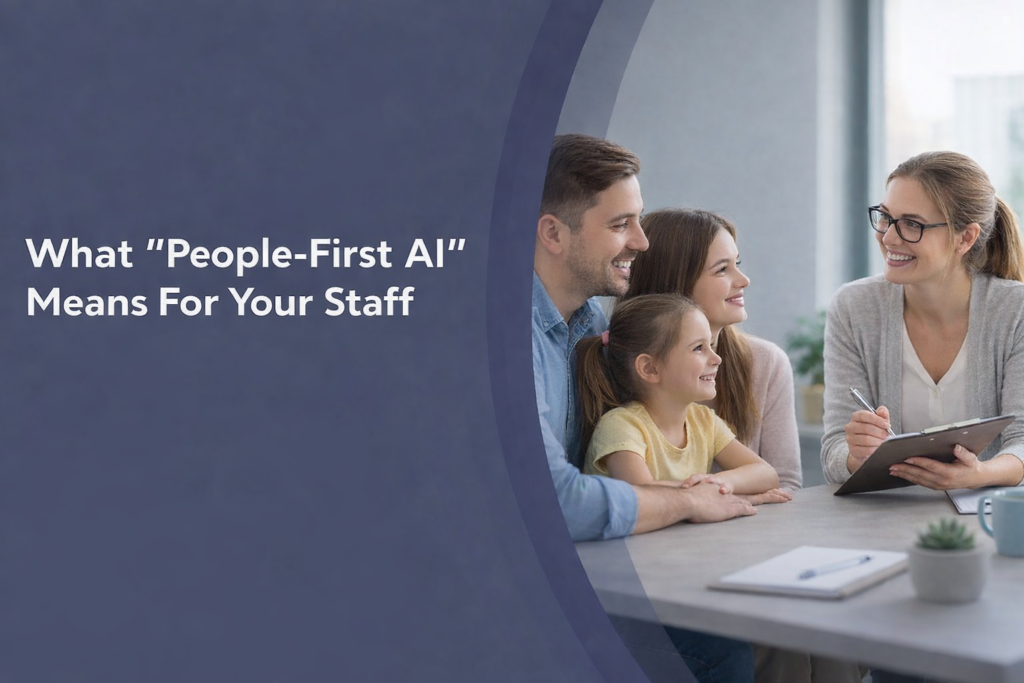
You didn’t take this job because you wanted to spend your afternoons filling out forms.
You took it because you wanted to make a difference. Because the work matters. Because the people you serve deserve someone in their corner. And yet, if you are honest about how your days actually look, a significant portion of your time goes to working on things that have nothing to do with why you showed up in the first place. Timesheets. Case notes. Progress reports. Data entry. Email after email after email. Yes, all of these are part of the job, but they take you away from what is most important, the people.
What “People-First AI” Means For Your Leadership Team
During your board meeting last night, someone asked whether the organization is being responsible about using AI. You recently learned that one of your staff members was using AI to help write clear case notes while another shared they are wondering whether AI might impact their job in the future.
What “People-First AI” Means For Your Board
“Should we be using AI?” One of your board members has read an article, attended a conference, or talked with someone from another organization that just launched something new. And the board member wants to know where the organization stands.
What Does “People First AI” Mean for Your Organization?
You have heard a lot about artificial intelligence over the past year or two as it has moved into the workplace. Some people are excited. Others are worried. Many are simply overwhelmed and unsure if and how it can be useful for them. In the nonprofit sector, those feelings come with additional questions about mission and ethics, the impact on staff, and the people you serve.
Welcome to NonprofitNext: Where Mission Meets What’s Possible
‘ve spent over 25 years working in the nonprofit sector. I started as a volunteer, got hired and worked on the front lines in service delivery for several years, and eventually led organizations at the executive level. Across all of these experiences, one thing stayed constant: the people doing this work genuinely care. They didn’t choose the work for the salary. They chose it for the mission and to make a difference.