This article is part of our complete guide: People First AI: A Complete Guide for Nonprofits.
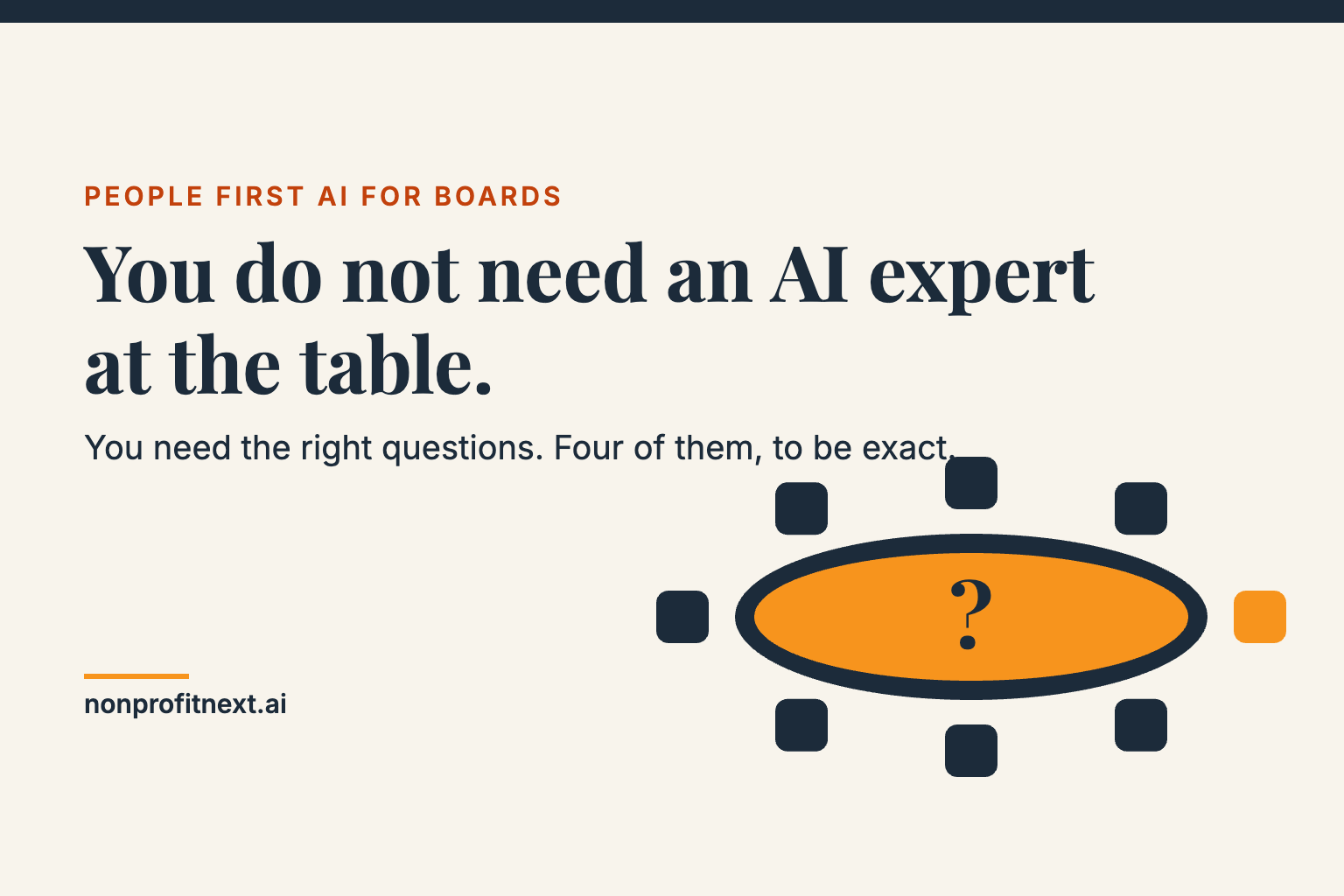
AI governance for a nonprofit board does not require anyone at the table to become a technical expert. It requires the oversight you already practice, pointed at a new set of decisions. The question usually arrives as “should we be using AI,” after a board member reads an article, attends a conference, or hears about something another organization just launched. It is the right question, framed too narrowly.
Most organizations are already using AI in some form, even if that just means staff using ChatGPT to draft an email or summarize a report. The more important questions are what the board’s role and responsibility look like as that becomes more common, and what thoughtful AI governance looks like for a nonprofit.
This is the first in a four-part series exploring what a People First approach to AI means for each of the four audiences at the heart of every nonprofit: the board, executive leadership, frontline staff, and the people you serve.
The Board’s Role Is Not to Become an AI Expert
You do not need to understand how AI works to govern it well. You do not need to know the difference between a large language model and a machine learning algorithm any more than you need to understand accounting software to exercise responsible financial oversight. What you need is a framework for asking the right questions and the confidence to ask them.
The board’s role in AI governance looks like the board’s role in everything else: making sure the organization’s values are reflected in its decisions, that risks are identified and managed, and that the people who depend on you are not harmed in the process.
The Mission Alignment Question
Every tool your organization adopts, every workflow it automates, and every system it builds should be traceable back to your mission. That can get lost quickly in the enthusiasm of a good demo or the pressure to keep pace with peer organizations.
A People First lens asks one question before any technology decision is made: does this make us more effective at serving the people we exist to serve? Efficiency matters. Reducing administrative burden genuinely frees up capacity. Efficiency that comes at the cost of the relationships, trust, and human judgment your programs depend on is not progress. Your board is positioned to hold that line precisely because you are not in the middle of the daily pressure to just get things done.
The AI Governance Questions Every Board Should Be Asking
Who owns the data? Who controls it, who can access it, and what happens to your information if you end a vendor relationship? These are basic stewardship questions that belong in your governance conversation.
What are the privacy implications for the people we serve? Your organization likely works with people already in difficult circumstances, and you may receive funding from foundations or government sources with their own data privacy requirements. Get a clear answer before any client-facing AI system goes live.
How are we protecting our staff? Are they being consulted and trained? Do they feel like this is being done with them or to them? Staff who feel overlooked in a technology transition disengage from it, and when that happens, even the best system fails.
What does success look like, and how will we measure it? Ask this about AI the same way you ask it about programs. Define what a good outcome looks like six months and a year from now, and expect leadership to report back on it.
This is not a new category of board governance. You already ask whether major investments align with the mission. You already hold leadership accountable for how resources are used. You already care about the wellbeing of the people you serve and the staff who serve them. AI governance is that same work applied to a new set of decisions.
Common Questions
Does our board need an AI expert? No. Boards govern AI the way they govern finances: with the right questions and clear reporting, not technical mastery.
What AI governance questions should a nonprofit board ask? Who owns the data, what the privacy implications are for the people served, how staff are being consulted and trained, and how success will be measured.
Should our board approve an AI policy? Yes. A short, plain-language policy naming approved tools, protected data, and an owner is a governance document, and adopting one is a concrete first step.
How often should the board revisit AI oversight? Put it on the agenda at least annually, or whenever a tool that touches client data is proposed. Treat it like any other standing risk area.
Getting ready for an AI conversation at your next board meeting? I am glad to talk it through with you, no jargon, just your questions and straight answers. Book a meeting at calendly.com/larry-nonprofitnext/30min.
Part 2 explores what People First AI means for the executive leaders responsible for translating board values into organizational reality.
Larry is the co-founder and Principal Innovation Strategist at NonprofitNext. Learn more at nonprofitnext.ai.