Most nonprofits already have the information they need to see whether program documentation is complete, services are being recorded correctly, and staff are meeting funder requirements. The challenge is finding time to review that information consistently. A Quality Assurance Tool makes that review practical and useful.
Case management systems are built primarily to collect and store information. They are generally less effective at helping managers evaluate the quality of that information across an entire program. Leaders still need to know whether required elements are missing from participant records, whether services documented in case notes match the services participants selected, whether staff are consistently documenting progress toward goals, and whether the same problems appear month after month.
Answering those questions often means manually reviewing hundreds of records and case notes, which makes meaningful quality assurance difficult to sustain. The NonprofitNext Quality Assurance Tool makes that review more practical by analyzing program records against rules established by your organization and funders, then producing detailed findings for staff and supervisors to review. AI can add another layer of insight, helping the tool review information that would otherwise take substantial staff time to examine.
The goal is not to replace professional judgment or your existing systems. It is to give nonprofit leaders a better way to see what is happening across a program, protect participant information, address problems, reinforce good practices, and improve the quality of the information the organization relies on.
It Works With the Systems You Already Have
The Quality Assurance Tool is not another case management system, and it does not require your organization to maintain the same information in multiple places. Your existing system remains the official system of record. The tool functions as an independent quality-assurance layer that reviews the information already there.
You select a reporting period and upload a spreadsheet export from your existing system. That export might come from Apricot, CaseWorthy, Salesforce, ETO, an HMIS platform, or another system that can produce spreadsheet data.
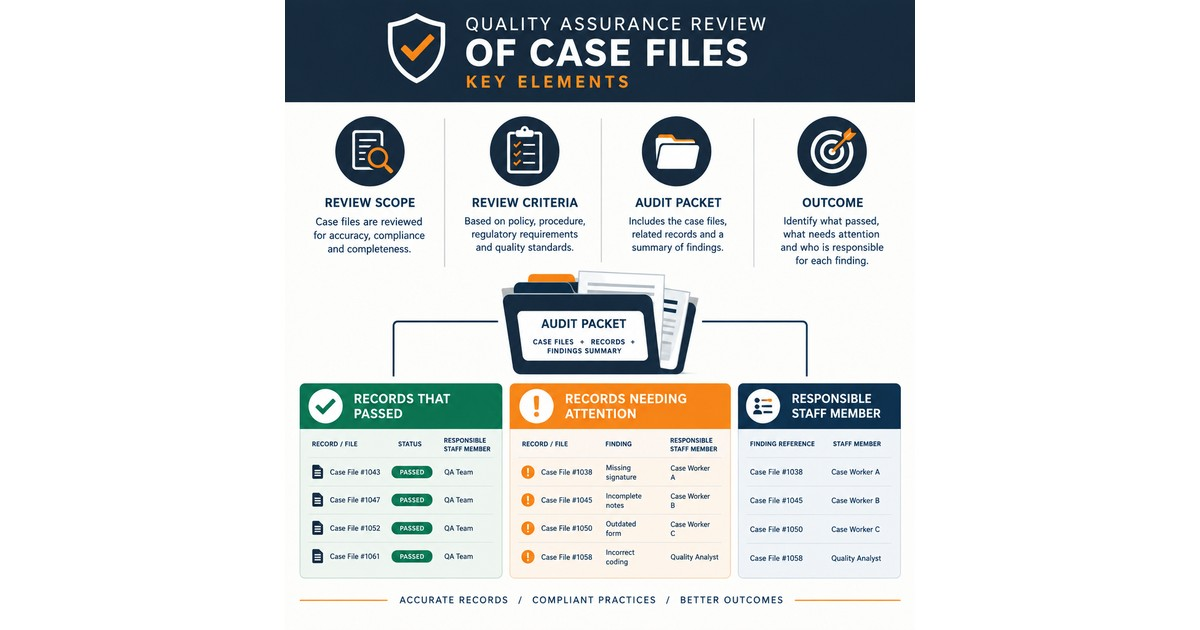
The tool reads the data, performs the review, and produces reports showing what passed, what needs attention, which records are involved, and which staff members should review the findings. Staff make any necessary corrections in the original case management system, so the tool never writes information back into participant records.
That separation is intentional. A quality assurance tool should help an organization understand its records without becoming another place where those records must be maintained. It also keeps responsibility for the official record where it belongs: with the organization's existing system and staff.
More Than Checking Whether a Field Is Blank
Basic data validation is useful, but nonprofits usually face more complicated documentation questions than whether a required field was completed. The Quality Assurance Tool can review structured information such as participant counts, demographics, service areas, intake and closure information, goals, services, required dates, missing or inconsistent information, and common data-entry errors.
Its more significant capability is reviewing the case documentation itself. That allows an organization to examine questions that traditional reports and dashboards often cannot answer because the relevant evidence is buried in narrative case notes.
For example, the tool can compare the services a participant selected with the services documented in case notes. If a participant selected transportation assistance but the documentation contains little or no evidence of transportation-related work, the tool can flag that record for review.
It also works in the other direction by identifying services that appear repeatedly in documentation but were never properly selected or recorded. In those situations, the organization may be providing legitimate services that are not accurately captured in its reporting. That can affect both program management and the organization's ability to demonstrate the work it is doing.
Follow Goal Progress Over Time With a Quality Assurance Tool
Having a goal in a participant record does not necessarily mean meaningful progress is occurring. Simply confirming that a goal exists gives a supervisor limited information. The tool reviews documentation over time to identify cases where progress may have stalled or where the record does not clearly show what has happened.
In some situations, the documentation may simply need improvement. In others, a finding may give a supervisor an opportunity to discuss whether a large goal should be divided into smaller, more achievable steps that better reflect the participant's progress.
Those findings are not automatic compliance failures. They are supervision prompts that draw attention to records that may deserve a closer look, while leaving the final judgment with the program staff and supervisors who understand the participant and the circumstances.
Reinforce Person-Centered Practice
Some program requirements appear in the language of a case note rather than in a checkbox or database field. That is especially true in programs built around consumer choice, self-direction, or person-centered planning, where documentation should reflect the participant's role in making decisions.
The tool can identify documentation patterns where staff appear to be prescribing actions rather than recording choices made by the participant. There is an important difference between notes that repeatedly say a participant was instructed to take an action and notes showing that the participant decided to pursue it.
The underlying service may be appropriate in both situations, and the difference may simply reflect a staff member's documentation habits rather than how services were actually delivered. Even so, those habits matter because the case record is often the primary evidence available to supervisors, funders, reviewers, and others trying to understand how the program operates.
Identifying those patterns early gives an organization an opportunity to address them through coaching and supervision. It also helps reinforce the program philosophy in daily practice, rather than waiting for an outside reviewer to raise the issue.
Your Rules, Not a Generic Checklist
Every nonprofit operates under a different combination of funding requirements, program standards, contracts, state requirements, and reporting expectations. Even two organizations providing similar services may need to document them differently because their funding sources or governing requirements differ.
For that reason, the Quality Assurance Tool does not rely on a single universal compliance checklist. The organization controls its rulebook, which can include requirements that apply across the organization as well as rules specific to an individual grant, contract, or program.
When funding requirements change, administrators can update the rulebook without rebuilding the application or waiting for a vendor to redesign the software. That lets the tool adapt to the way the organization actually operates instead of forcing the organization into a generic quality-assurance model.
Each finding can also include the specific rule or requirement behind it. Staff receive more than a warning that something may be wrong. They can see why the item was flagged and what they need to review.
Turn Quality Assurance Into a Management Process
Finding documentation problems is only useful if somebody can act on them. For that reason, reports are organized around the staff members responsible for the records, rather than delivered as one enormous list of issues for management to sort through manually.
Each finding can include:
- The issue identified
- The record involved
- A suggested action
- The rule or requirement associated with the finding
- Space for staff and supervisor review and sign-off
This structure makes quality assurance part of the regular supervision process rather than an isolated administrative exercise. Managers can review documentation issues with individual staff members, document follow-up, and identify areas where additional training or clarification may be needed.
The tool also compares current findings with earlier reviews so recurring issues are easier to see. A single missing field may be an isolated mistake. The same problem appearing repeatedly over several months may point to a training issue, a workflow problem, unclear policy, or a limitation in the organization's case management system.
That distinction gives leadership information that is difficult to get from individual case reviews alone. Instead of only correcting errors, the organization can begin identifying the operational reasons those errors keep occurring.
See Problems While They Are Still Small
One of the biggest advantages of regular quality assurance is timing. Documentation problems become harder to address the longer they sit. By the time an organization finds an issue months later, staff may not remember the circumstances, employees may have left, supervisors may have changed, and reconstructing what happened can be difficult.
A recurring review changes that dynamic by identifying potential issues while the work is still recent. Supervisors can address documentation problems earlier, staff can make corrections while they still understand the circumstances, and recurring patterns can be addressed before they become established habits.
That can improve documentation quality, strengthen staff supervision, produce more accurate reports, and reduce the cleanup required at the end of a reporting period. It can also help leadership see program-wide trends that would be difficult to identify by reviewing individual records one at a time.
And Yes, It Helps With Audits and Funder Reviews
Preparing for a monitoring visit or funder review is an important use of the tool, but it is not the primary reason quality assurance should happen. An organization should understand the quality of its documentation because it affects program management, supervision, reporting, and decision-making throughout the year.
When a formal review does occur, the organization has already been examining many of the same issues a monitor is likely to examine. That includes whether services are supported by documentation, required information is present, dates make sense, goals and services are documented appropriately, and known problems are being corrected.
The tool also maintains a record of each review, giving the organization evidence that quality assurance is an ongoing management practice rather than an activity that begins when a monitoring notice arrives. Instead of spending the weeks before a review manually examining hundreds of records at once, leadership can draw on a process that has already been operating throughout the year.
Audit and monitoring readiness becomes a byproduct of good management rather than an annual emergency. The organization is better prepared because it has been paying attention to documentation quality all along.
Protecting Participant Information Before AI Is Involved
Case documentation can contain some of the most sensitive information a nonprofit holds, so privacy cannot be an afterthought. The Quality Assurance Tool is designed to remove personally identifiable information before case documentation is sent to an AI model.
A scrubbing process running on the organization's own server removes information such as names, addresses, phone numbers, dates of birth, and internal case identifiers. Internal case numbers are replaced with temporary aliases, while the information needed to connect those aliases to the original records remains on the organization's own systems.
The AI therefore receives documentation without the information needed to directly identify an individual participant. The AI connection also uses commercial API terms and a business associate agreement under which submitted information is not used to train the provider's models and is not retained by the AI provider.
There is another important safeguard: AI-generated findings remain items for review, not decisions imposed on the organization. The tool does not automatically alter participant records, declare that a case has failed, or replace the judgment of program staff and supervisors.
Instead, it identifies something that deserves attention, explains the rule behind the concern, and leaves the final determination to a person. Human review remains part of the process from beginning to end.
Designed for Different Human Services Programs
The first version of the Quality Assurance Tool was developed for Centers for Independent Living, but the underlying model can apply to many programs where participant records must support services, outcomes, and compliance requirements. If an organization has structured program data, narrative documentation, and defined expectations for what those records should contain, much of the quality-assurance process may be automated.
Potential applications include:
Centers for Independent Living
Consumer service records, independent living plans, services, goals, consumer choice, and federal reporting requirements.
Housing and HMIS programs
Documentation requirements, housing plans, services, and funder-specific rules.
Workforce programs
Eligibility documentation, individual employment plans, services, measurable skill gains, and case documentation.
Home visiting and family services
Required intake information, visit frequency, service documentation, and progress toward participant goals.
Reentry and refugee resettlement programs
Enrollment requirements, service plans, follow-up activities, and grant-specific documentation.
Senior and community-based services
Assessments, care plans, service records, timeliness requirements, and program-specific documentation standards.
The specific rules will vary from one program to another, which is why the tool's configurable rulebook matters. The goal is not to impose the same quality standards on every nonprofit. It is to automate review around the standards each organization is already expected to meet.
No Per-User Subscription
The Quality Assurance Tool is installed on hosting owned by your organization, which means there is no ongoing NonprofitNext subscription or per-user licensing fee. Once installed, the organization's ongoing expenses consist primarily of hosting costs and the AI processing required when a review is run.
Current AI processing costs are well under a dollar for a typical run, and hosting generally costs only a few dollars per month. Adding staff members or expanding the number of people using the reports does not create additional license fees.
This model also means the organization owns its environment and remains in control of its data. The product is designed to become part of the organization's technology infrastructure rather than creating another vendor-controlled repository for sensitive participant information.
Accessible Reports You Can Actually Use
Quality assurance information should not be trapped inside a proprietary dashboard that only a few people can access. Reports can be reviewed in a browser and produced in accessible formats, including tagged PDF and Word versions. The application itself is designed to work with assistive technology.
That flexibility makes it easier to use the same information in staff supervision, management meetings, board discussions, internal quality reviews, and conversations with funders. Organizations do not have to recreate the information in another format every time a different audience needs to review it.
Quality Assurance Should Tell You Something Useful
The point of a Quality Assurance Tool is not simply to produce another report. It is to help an organization understand what is happening in its programs and identify where attention is needed.
Leadership should be able to see where documentation problems are occurring, which requirements are regularly being missed, whether services are recorded accurately, whether participants' choices are reflected in their records, and whether staff are documenting meaningful progress. It should also be possible to see whether the same issues appear month after month and whether organizational processes need to change.
When a funder eventually asks many of those same questions, the organization should be able to demonstrate that it has already been asking them. That is what the NonprofitNext Quality Assurance Tool is designed to make possible.
The Quality Assurance Tool is available now. Pricing is published in the NonprofitNext Investment Guide, and additional information and demonstration screens are available on the Quality Assurance Tool page. Those resources provide a closer look at the product and the types of reports it can produce.
If you want to know whether the tool would work with your programs, send us a message through the NonprofitNext contact form. We can tell you whether the tool already evaluates them and what would be required to add the ones it does not.
Larry is the co-founder and Principal Innovation Strategist at NonprofitNext. NonprofitNext develops practical AI and technology solutions designed around the operational needs of nonprofit organizations.