
Solution Detail
The Quality Assurance Tool: an Audit for Nonprofit Data Quality
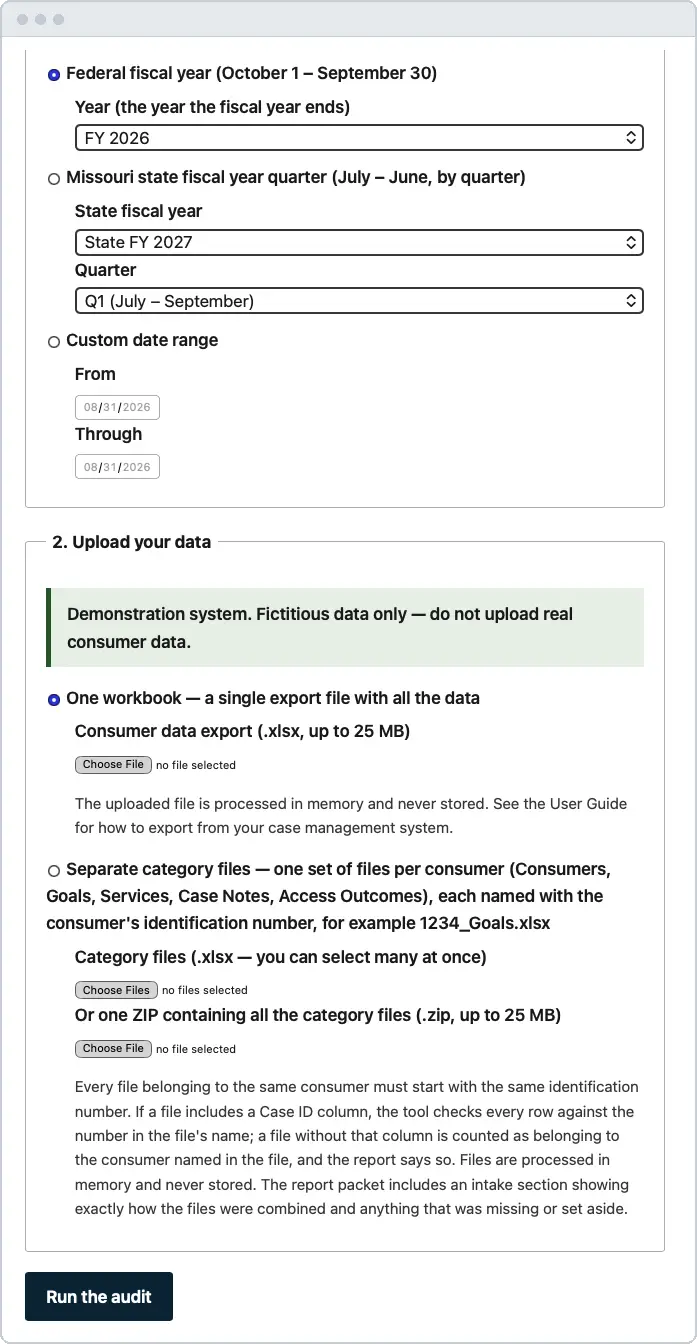
The Quality Assurance Tool is designed to provide a monthly review of a nonprofit’s program and service records. A program lead uploads one spreadsheet export from the case management system (Apricot, CaseWorthy, Salesforce, ETO, an HMIS export, or any system that exports a spreadsheet) and chooses the reporting period. Minutes later, leadership has a complete audit packet: what passed, what needs attention, which staff member each item belongs to, and the exact reporting rule behind every finding. It is an audit tool, not a second reporting system; the case management system remains the official record, and the tool never changes anything in it.
Where Else This Fits
Originally built for Centers for Independent Living, the tool works for any documentation-heavy program whose funders audit the case file. The rulebook and the review are configured to your program.
- Housing First and HMIS programsThe rulebook holds the HMIS data standards and the funder’s documentation rules, and the review checks that services in the notes match the housing plan the client chose.
- Workforce programsWIOA eligibility elements, individual employment plans, and measurable skill gains are checked against the case file, with findings routed to the career coach responsible.
- Home visiting and family servicesVisit frequency, goal progress, and required intake elements are reviewed every month, and the packet answers the monitor’s questions before the monitor asks them.
- Reentry and refugee resettlementEnrollment, service plan, and follow-up documentation reviewed against the grant’s own rules.
- Senior case managementOlder Americans Act assessments, care plans, and service logs checked for completeness and timeliness.
- Independent living centersThe original configuration: consumer service records, independent living plans, and the federal report counts.
How We Protect the Information You Trust Us With
The Quality Assurance Tool reads case documentation, so we designed it to protect the people in those records. Before it reads a single case note, every name, address, phone number, and case number has already been removed.
- No personal information reaches the AI.Names, contact details, and anything else that identifies a person are removed or never collected before the AI sees a single word. The AI works with the question or the pattern, not the person.
- Nothing is used to train AI models.We use the AI through business agreements that forbid the provider from learning from your information. What your organization sends is used to answer, and for nothing else.
- Nothing is kept.Information is processed and released. The AI provider does not store it, and the tool does not build a copy of your records anywhere. Your own systems remain the only record.
- NonprofitNext keeps nothing.Because your organization owns the tool and its own AI account, no data or records belonging to your organization ever sit with us. When the build is finished, we walk away with nothing but the lessons learned.
It Reads the File the Way a Reviewer Would
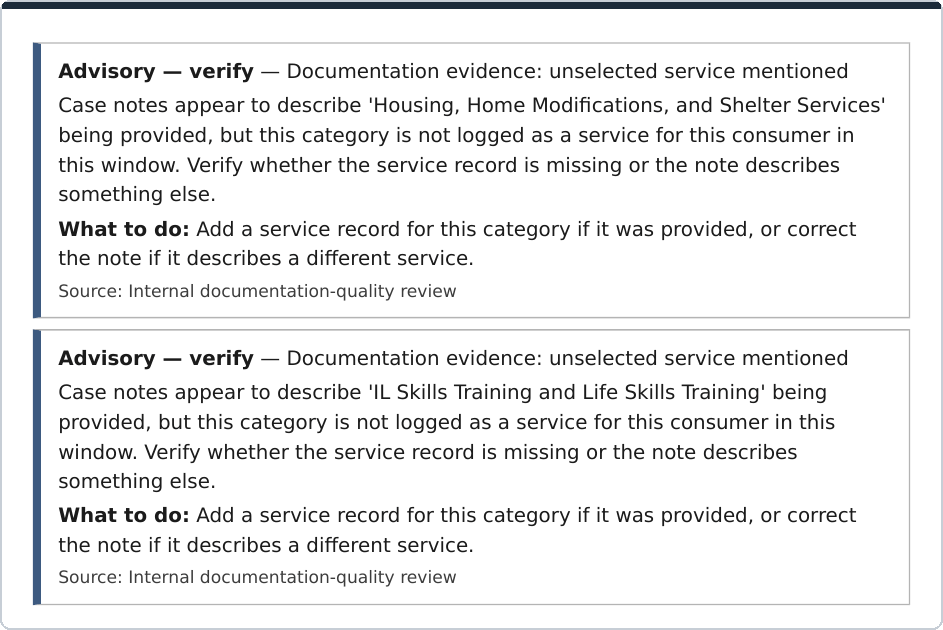
We have not found another tool that does this. Beyond counting and category checks, the tool reads the case documentation itself and reports on service delivery. It verifies that the services each participant chose are actually being delivered and documented in the notes, and flags when services are showing up in the record that were not selected during intake, so your organization is credited for the work. It watches for steady and timely progress toward each goal, and where a large goal has stalled, it suggests splitting the goal into smaller steps that might serve the participant better. It also highlights documentation where actions are being prescribed to participants rather than chosen by them, a check that individuals are directing their own services: consumer choice in independent living, person-centered planning in housing, aging, and behavioral health programs.
Findings from the review arrive as advisories, each worded as an item to verify. The tool asks the questions a program auditor would ask and highlights the steps you should take to address the issues it identifies.
Personal Information Never Reaches the AI
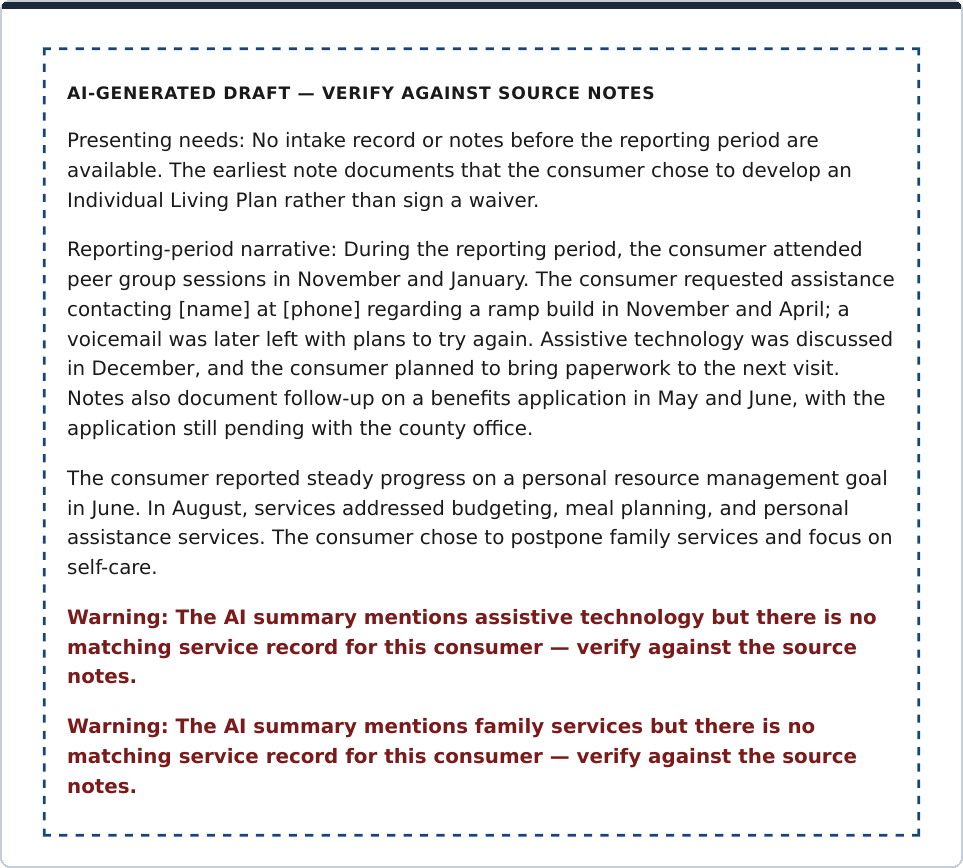
Before AI reads a single case note, a scrubbing engine running on the organization’s own server removes personally identifiable information: names, phone numbers, addresses, and dates of birth are replaced with placeholders, and even internal case numbers are swapped for one-time aliases that are translated back only on the organization’s own systems. No identifier of any kind leaves the organization. The tool uses the AI through its API directly, operating under commercial terms in which the provider neither stores what it receives nor uses it for model training, and every AI-drafted summary is labeled as a draft to verify against source notes.
The Compliance Audit Arrives in the Same Packet
The rules come from your funders, not from us. The tool ships customized to your organization, ready to audit against the requirements of any grant: federal, state, local, or private foundation. The rulebook lives in a spreadsheet an administrator edits, so a new grant’s requirements are an edit, not a software project. Checks cover consumer counts, closures, demographics, service areas, goals, services, date sanity, and typos, which come back with the fix attached.
Findings Land on the Right Desk
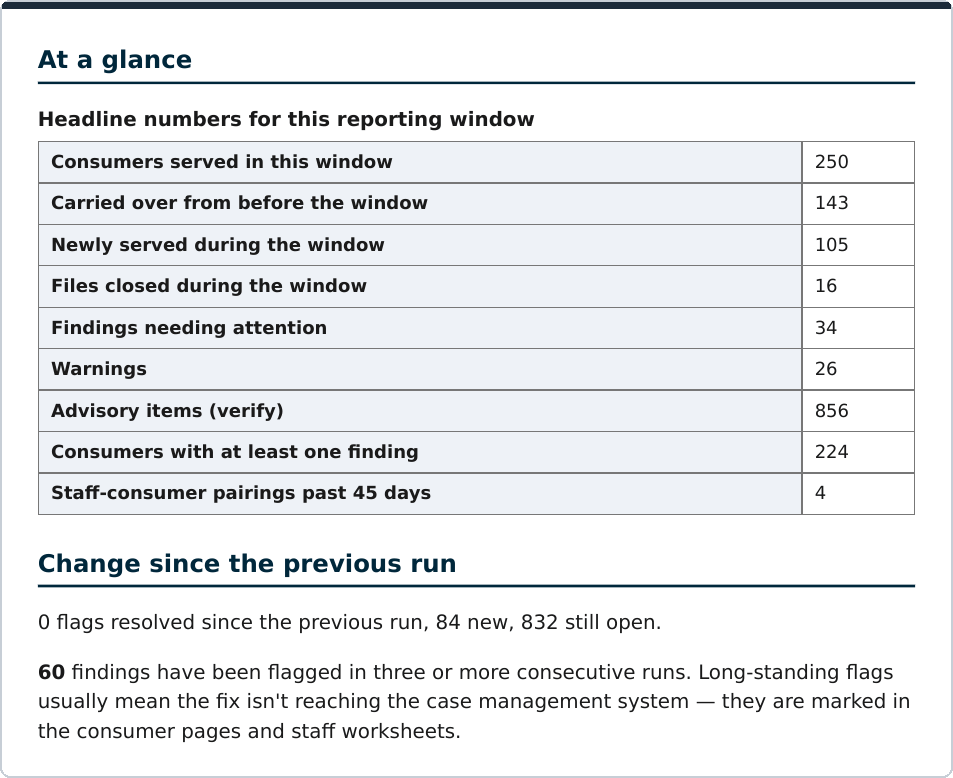
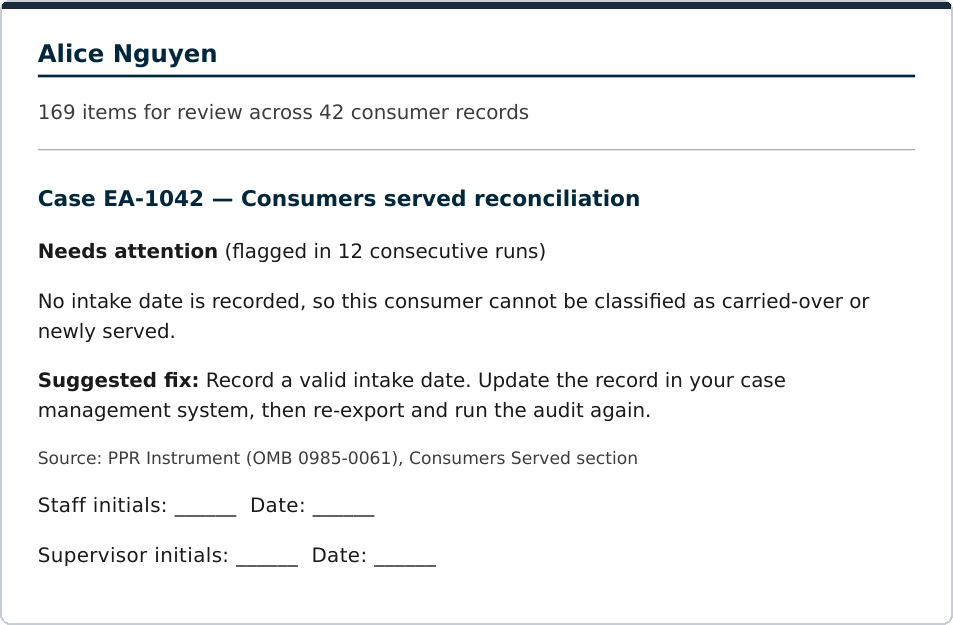
Worksheets arrive grouped by the staff member responsible for each item. Each finding carries the problem, the suggested fix, the rule citation, and sign-off lines for staff and supervisor initials, so the supervision conversation is built into the paper. Every run compares itself to the last one and marks items flagged across consecutive months, and every run is logged. When a funder or grant monitor asks how the organization supervises its documentation, the answer is on screen.
Proven Before It Reaches You
In acceptance testing, the tool reviewed a fictitious 260-record dataset seeded with dozens of known data problems spanning every check. It caught every one, assigned each to the correct case and staff member, and raised no false alarms on the clean records, with the result confirmed by an independent review. The source code has been examined by an external security review, and an automated suite of more than three hundred tests runs on every change, including tests that verify no real identifier ever appears in an outgoing AI payload. The tool is available now.
Owned, Not Rented
There is no NonprofitNext subscription and there are no per user fees. The tool is installed on hosting the organization owns; ongoing costs are a few dollars of hosting each month and well under a dollar of AI processing per run. Every page is accessible and works with assistive technology. Reports are produced in a browser view, a tagged PDF, and Word versions.
Tools Used
- One Spreadsheet Upload
- Editable Rulebook
- AI Documentation Review
- PII Scrubbing on Your Own Server
See It Run on a Full Demonstration Dataset
The fastest way to judge this tool is to watch it audit 250 fictitious records and hand back the packet. Schedule a call and we will run it live on the demonstration system.