Can AI write a grant proposal? It can write a draft of one. It cannot supply the true numbers, the knowledge of your community, or the relationship with your funder, and those are the parts a strong proposal is built on. Grant writing is one of the first places nonprofits reach for AI, for good reason: the work is repetitive and deadline-driven, and there is never enough time. So the practical question is which parts of the job to hand to a tool and which parts need to stay with your team.
This post gives you the short answer. Our full guide to using AI for grant writing goes deeper, with the drafting instructions I use, the privacy boundaries to set, and a step-by-step workflow.
In this post: what AI drafts well, what only your organization can supply, what a proposal written entirely by AI looks like, why the funder relationship stays with you, and answers to the questions I hear most.
What AI Drafts Well
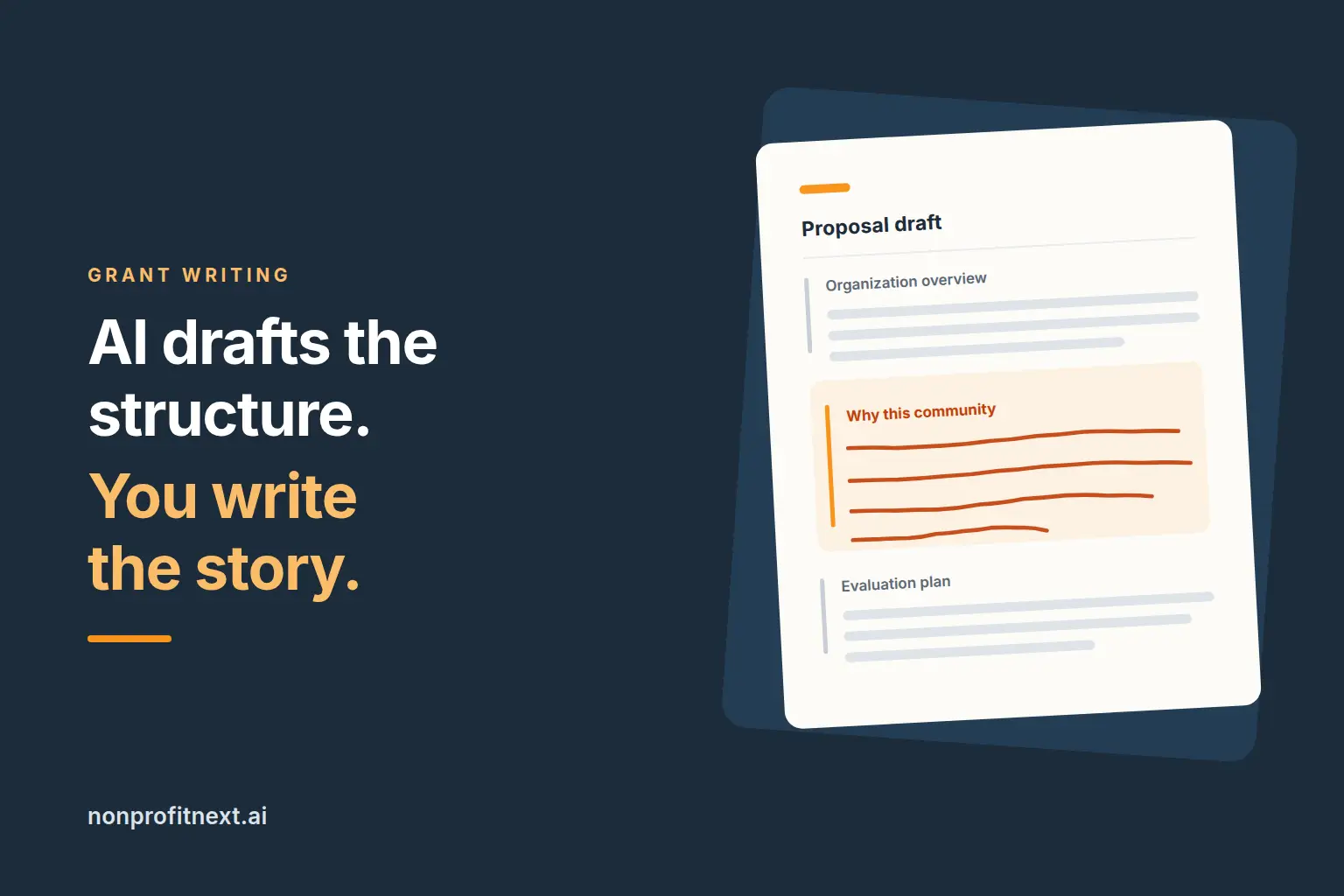
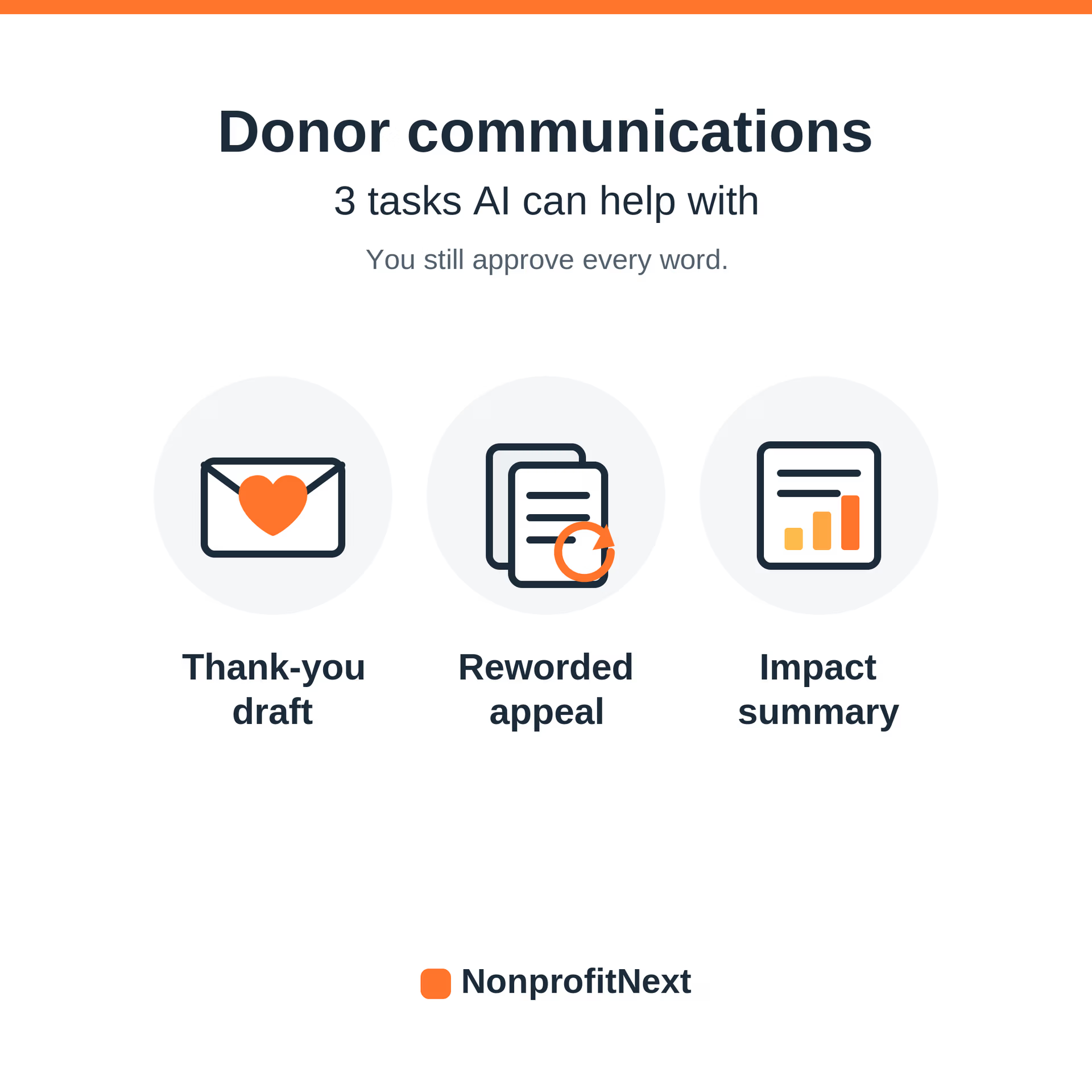
AI is strong at the scaffolding of a proposal. Give it your notes and your outcome data and it will produce a structure you can react to instead of a blank page. It will reword the narrative you wrote for one funder to fit another funder’s questions and word count. It will take ten pages of program data and pull out a plain summary for you to check, and it will catch the requirement you said you would address and have not yet addressed.
For a small team, that is real time back. A lot of grant writing hours go to just getting started, and clearing the blank page lets you spend your energy on the parts that need a person. If you submit several proposals a year built on one core case for support, AI is good at reshaping that core to fit each funder so you are not rewriting from zero every time.
What Only Your Organization Can Supply
AI does not know your work. It was not in the room when a participant’s life changed, and it has no idea what your staff learned this year or what local employers keep telling your program director. The reason your approach fits your community lives in your team’s experience, and no training data contains it.
The numbers are the same story. Ask a tool to describe your impact without giving it your data and it will invent statistics, outcomes, and citations, stated with complete confidence. Every figure in an AI draft is a guess until you have checked it against your own records. In a document that has to be true, a tool that is happy to guess needs close supervision.
Can AI Write a Grant Proposal on Its Own?
Imagine handing a tool the funder’s questions and nothing else, then asking for a complete proposal. What comes back looks finished. The structure is clean, the tone is confident, and every section is filled in. Read it closely and the problems surface. The need statement could describe any city in the country. The program description is a plausible average of a thousand programs that are not yours. The outcomes sound impressive and rest on nothing your records support.
The tool did the only thing it could do with what it was given, which is fill every gap with the most typical language available. A proposal is supposed to argue that your organization, in your community, is the right one to fund, and typical language cannot make that argument. The fix is the order of operations. Your material goes in first, and the tool drafts second.
The Funder Relationship Stays With You
The relationship with your funder is the part of grant work no AI tool can handle. Behind most awards is a program officer who took your call, told you what the foundation cares about this year, and read your reports. A site visit that goes well, or a follow-up conversation after a decline, can shape what happens with your next application. Funders give to organizations they trust, and that trust builds over years of showing up and doing what you said you would do.
AI cannot build that trust for you, but it can help you prepare. Before a call, ask it to summarize a funder’s published priorities and recent awards. After the call, have it turn your notes into a list of follow-up items so nothing slips.
Getting the Time Savings Without the Risk
The safe pattern fits in three sentences. Write the raw material yourself first: the real numbers, what your staff is seeing, and who you serve, with anything that identifies a specific person kept out of tools your organization has not vetted. Then let AI shape that material into the funder’s structure, cut it to the word limit, and smooth the transitions. Then check every number, name, and claim against your records before anything goes out, because the responsibility is yours.
Our guide to using AI for grant writing walks through each step in detail, including the exact drafting instructions I recommend and the compliance check at the end, and our data privacy and ownership page covers how we think about where your information goes.
Common Questions
Can AI write a grant proposal by itself?
It can produce a document that looks complete. Without your material it fills every gap with generic language and invented specifics, so a proposal written entirely by AI is a risk to your credibility rather than a shortcut. Give it your real numbers and program knowledge, and treat what comes back as a first draft for your team to verify and edit.
How much time can AI actually save on grant writing?
The time savings depend on where and how you use it. Reshaping approved material for a new funder, editing your responses to meet word limits, and drafting reports from work you have already done are the biggest wins. The first proposal you create this way saves the least amount of time because you are still building your source documents and instructions. But the time savings grow from there as everything you build gets reused.
What parts of a grant proposal should a person always write?
The parts a funder could only get from you: why this community needs the program, why your organization is the one to run it, what your staff and participants have taught you, and the final check on every fact. If a sentence shows a reviewer your actual work, a person wrote it or verified it.
Should we buy an AI tool built just for grant writing?
I would not start there. A general-purpose AI assistant handles the restructuring, trimming, and plain language work well, and using one teaches you where AI actually helps your process before you commit to a subscription. Once you know your real bottleneck, you can evaluate specialized tools against it. The tool comes last.
Grant season has a way of arriving before the team is ready for it. If you want help deciding which parts of your grant work AI should carry and which parts belong to your staff, I am glad to talk it through with you, no jargon, just your questions and straight answers. Schedule a call with me at calendly.com/larry-nonprofitnext/30min.
Larry is the co-founder and Principal Innovation Strategist at NonprofitNext. Learn more at nonprofitnext.ai.