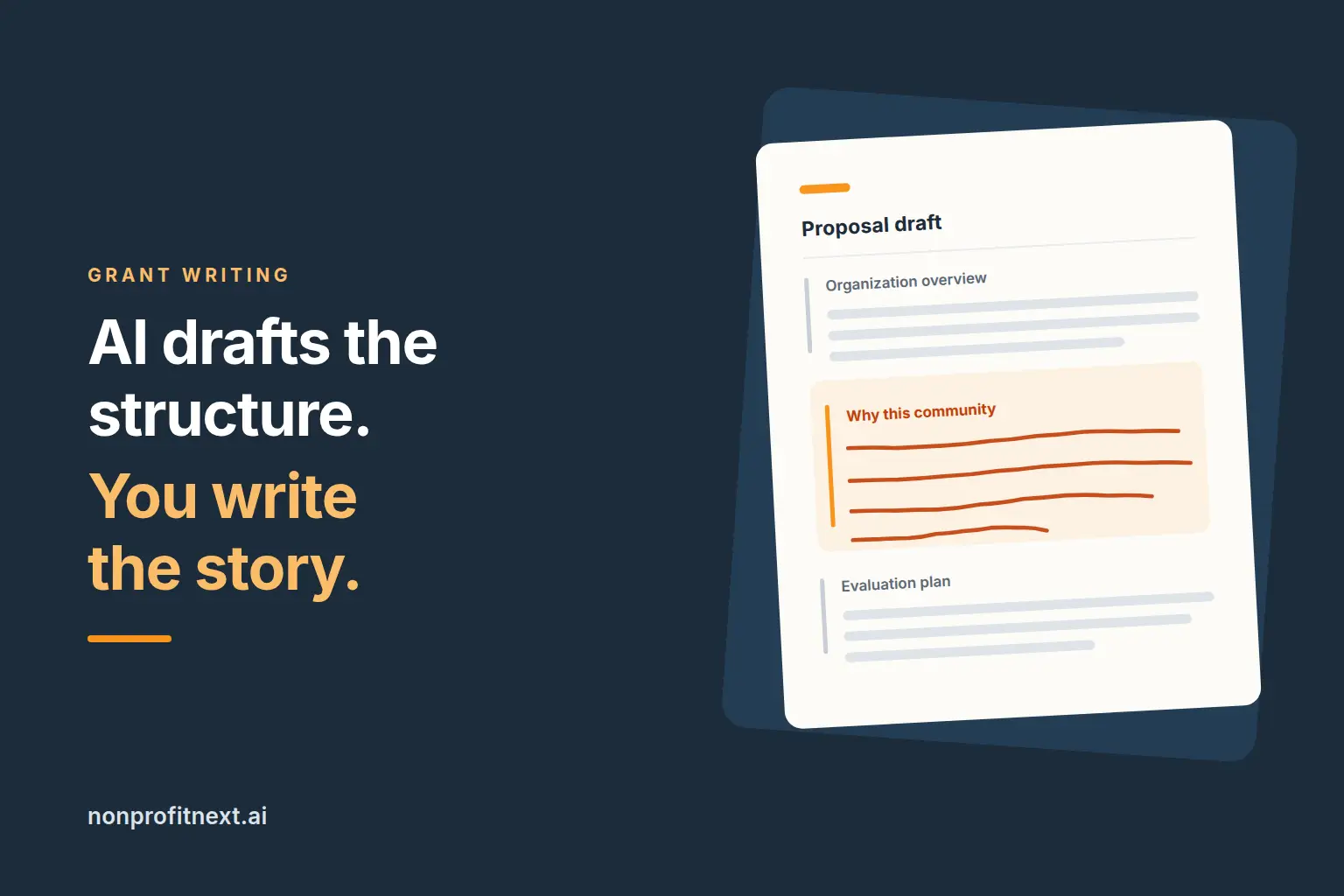
When using AI for grant writing, keep it away from the part of the proposal only your organization can write: why this community, why your organization, why now. Meanwhile, AI can save you significant time on the structured boilerplate language sections of a grant proposal, and I recommend using it. Knowing where to draw that line is a skill worth learning.
Your organization is the only source for what it knows: the program, the community, the people you serve, and what the work has taught your staff. Turning that material into clear sentences that answer a funder’s questions is a separate job, and that second job is the one AI can take on.
In this post: what AI should never touch in grant writing, why specificity matters to a reviewer, where AI saves real time, a walk-through of a proposal workflow, the data boundaries to set before anyone opens a tool, and how to handle disclosure.
What AI should never touch in grant writing
Four rules cover most of what can go wrong here. Agree on them with your staff before the next application is due, while there is still time to think them through.
Your organization’s story
Every strong proposal carries material that could only have come from you. The reason the program began, a change your staff has seen this year, something participants keep saying, a lesson from an approach that did not work, a detail about the neighborhood that explains why a program designed somewhere else would fail here. AI does not know any of that unless you tell it, and when it does not know, it is very good at producing language that sounds as though it does.
Ask a tool why a youth employment program matters and you will get a clean paragraph about opportunity, economic mobility, and brighter futures. There is nothing incorrect in it. There is also nothing in it about the young people you serve, the employers you work with, or the reason your program looks the way it does.
Facts, numbers, and sources you did not provide
If you did not supply the fact, do not assume the tool knows it. AI systems fill gaps confidently, and a draft can come back holding a local poverty statistic, a demographic breakdown, a research citation, or a program outcome that nothing in your materials supports. In casual use that is an annoyance. In a grant proposal it becomes a problem with your organization’s name on it. Verify anything you did not put there yourself, and delete what you cannot verify.
Client information that has not cleared your rules
A client’s story can carry a powerful statement, and it is still that client’s private life. A diagnosis, a housing status, an immigration history, a family situation: all of it stays sensitive when you are using it to raise money. Before any of it goes into a tool, your organization needs to know which tool, what it retains, what protections your agreement actually carries, and what your own policy allows.
The best approach when using an AI tool to help with grant writing is to draft with generalized or de-identified details and add the specifics later, inside a system you have approved. Our data privacy and ownership page covers how we think about where data lives.
Anything you have not read closely
An AI draft reads smoothly enough that you can be tempted to skim it, and skimming is how an unverified number ends up in a submitted application. Every figure, date, program name, partner, and claim in that file is your organization’s responsibility. The funder is deciding whether to trust you with its money, and every sentence you send is part of that decision.
Why specificity matters
Reviewers read a lot of applications describing similar problems in similar vocabulary. Funding decisions turn on fit, timing, budget, relationships, and how crowded the pool is. Being specific about your organization, your existing programs, the program you are proposing, and other information about your organization is essential. The details you share give a reviewer concrete information about your work, while generic language that AI models can produce gives up that advantage.
Say a workforce program is answering a question about need. One version reads: “Our organization provides comprehensive employment services that help individuals achieve greater economic independence.” The other reads: “Sixty-three percent of the people who entered our program last year had been out of work for more than six months, and local employers keep telling us the barrier they see is transportation, not job openings.” The first sentence could describe hundreds of organizations. The second one could only have been written by your staff, because the percentage came from your own intake data and the employer feedback came from conversations your team had.
This is language that makes your proposal strong: what your staff is seeing, what participants are telling you, what changed in your community, what you tried before, and what your data means in context. AI can help you organize that material after you provide it. It has no way to come up with any of it on its own.
What AI for grant writing does well
Once those boundaries are set, the time savings are real. Most of them come from work your organization has already done and now has to reshape for a new reader.
Most grant writers are not starting from scratch. You have last year’s proposal, a program description, outcome data, a logic model, a budget, staff bios, and evaluation language, and a potential funder is asking many of the same questions in a slightly different order. Handing your approved material to an AI tool and asking it to adapt that material to the new question is a much better use than asking it to write something fresh.
Trimming to word limits is the simplest win. You have written 473 words and the box allows 250. Instead of thirty minutes of shaving phrases, ask for a shorter version that keeps specified numbers and points intact, then compare it against your original. Let the AI handle the cuts and keep decisions about what has to stay in the response for yourself.
Developing plain language is another win. Your staff knows what wraparound service coordination means, and a community foundation trustee may not. AI is good at spotting the jargon and offering a clearer version.
Writing your monthly or quarterly reports may be the biggest win of all. By the time a quarterly or final report is due, the work has happened and you already know what you promised, what you did, where you missed a target, and what you learned. Reformatting known information into the funder’s structure is work AI does well. The time savings add up when you think about using this approach across every grant you have.
This changes what is possible for a small shop. The organization that skipped applying for certain grants in the past because nobody had the time available to write the proposal may be able to make it work by using AI as a helper.
For a direct answer to the question most people start with, see our post on whether AI can write a grant proposal.
A walk-through: drafting a proposal with AI
Here is the workflow I recommend, using a community foundation application as the example.
Gather your source material first: the funder’s questions, proposals you have previously written, your current program description, current outcome data, the project budget, your logic model, and any community data you plan to cite. AI cannot fix weak sources. If your numbers are stale or your budget is unfinished, drafting the prose faster does not fix any of that, so get the underlying material right first.
Write a draft of the sections only your organization can write before you open a tool. Why the problem matters here, what has changed, why you are the one to respond, what participants have taught you. Bullet points are enough at this stage. Doing this first keeps your voice from being anchored by a machine draft.
Then hand over the structured sections with explicit instructions. Mine look like this: “Draft a response to this question using only the material I have provided. Keep it under 400 words. Preserve all program numbers exactly as written. Do not add statistics, citations, outcomes, or partnerships. If the material does not answer part of the question, insert [INFORMATION NEEDED] rather than filling the gap.” The restrictions written into this prompt will help to keep AI from inventing information or straying too far.
Verify the draft against your sources line by line. Read it the way you would read a draft handed to you by a new staff member who does not know your program yet. Check every number, date, program name, and partner. Watch for causation language your data does not support, and for quiet inflation: “we served 200 participants” should not become “we changed the lives of more than 200 people.”
Then cut the generic language. Sentences about creating lasting change, addressing critical needs, and serving those most in need can go without losing anything, and they are using space you could spend on evidence. If another nonprofit could paste its name into a sentence and change nothing else, rewrite it.
Assemble the pieces and read the whole thing start to finish: your sections and the corrected structured sections, one pass to standardize terms and fix transitions so the seams disappear, and the tone your organization actually uses with this funder.
Do the compliance check by hand. Word and character limits, attachments, budget totals, signatures, certifications, every required question, the deadline. The tool that drafted sections of the proposal may not have read the application instructions, and compliance is still your responsibility.
The first proposal through this workflow will not save you much time, because you are building the workflow: deciding what source material to keep, learning which instructions work, and finding where the tool is weak. By the third or fourth you have a reusable set of documents, standing instructions, a privacy rule everyone knows, and a review checklist.
Disclosure: what to tell funders when using AI
There is no single rule. Requirements differ by foundation, agency, and program, and they keep changing, so the operational answer is to read the current instructions for each application. If the application asks about AI use, answer honestly. If a funder prohibits a particular use, follow the prohibition. If you hold grants from several sources, set an internal baseline your staff follows even when the funder says nothing at all.
My own standard is to use AI in a way you would be comfortable describing to the program officer. “We used it to restructure existing program information, cut several answers to the word limit, and draft the budget narrative from our own figures. Staff verified every fact and wrote the program narrative.” That is a defensible description. If saying it out loud would make you wince, change how the tool is being used before you spend any time on how to word the disclosure. Put your rule in your organization’s AI use policy so nobody is improvising at 11 p.m. the night a proposal is due.
Where this fits in your bigger AI picture
If you are new to AI, I would not make grant writing your first experiment. Start somewhere lower stakes: internal drafts, meeting summaries, routine communications, adapting material you have already approved. AI can produce great results if used properly. However, it can give you terrible work with exactly the same confidence. Learn to see the difference before you apply it to something carrying money, compliance, and privacy consequences. If your organization is early in this, start with the AI for Nonprofits guide and come back once reviewing AI drafts feels routine.
The order stays the same everywhere: mission, staff, the people you serve, and the tool last. In grant writing that order has a concrete meaning. The mission is why the money matters, your staff supplies the knowledge and judgment, your clients’ privacy outranks your deadline, and the tool handles the mechanics where it saves time without taking authority away from the people responsible for the work.
Common Questions
What should AI never do in a grant proposal?
It should not invent facts, statistics, citations, outcomes, or partnerships, and it should not receive client information your organization has not cleared for that use. It also should not be handed the judgment calls: why your program matters, what your community needs, and what your results mean. Those come from staff who know the work.
Which parts of a grant proposal can AI handle?
It handles the structured sections well: adapting an existing program description, summarizing outcomes, drafting a budget narrative from verified figures, improving clarity, and cutting answers to a word limit. Your organization supplies the facts, the program knowledge, the examples, and the final judgment. Treat it as a drafting and editing assistant rather than the author.
Will funders know if I used AI?
Funders are increasingly asking for transparency. If they ask, be open and honest. What matters is whether the proposal reflects your organization accurately, meets the funder’s requirements, protects sensitive information, and makes only claims you can support. Build a workflow you would be comfortable describing whether or not anyone asks.
Do funders allow AI in grant writing?
There is no universal rule. Some funders give explicit instructions about AI use, many say nothing, and the guidance is changing, so check each application rather than assuming. Write your own standard down as well, so staff are not making that call alone under deadline pressure.
If grant season leaves your team staring at more blank pages than you have time for, an hour spent sorting which parts of that work AI can take on and which parts have to stay with your staff can save you real time over the rest of the year. I am glad to talk it through with you, no jargon, just your questions and straight answers. Let’s talk at calendly.com/larry-nonprofitnext/30min.
Larry is the co-founder and Principal Innovation Strategist at NonprofitNext. Learn more at nonprofitnext.ai.