An effective AI strategy for nonprofits comes down to two things that work together: a simple plan for where AI should help your organization and a small, well-chosen first project that proves the plan can work. You do not need a fifty-page document or a technology overhaul to have a real strategy.
The 2026 Nonprofit AI Adoption Report from Virtuous and Fundraising.AI, based on a December 2025 survey of 346 nonprofits, found that 92 percent of nonprofits now use AI. Yet only 7 percent reported major improvements in their ability to achieve their mission. Most organizations described their AI use as reactive and individual: one-off prompts rather than coordinated efforts tied to organizational priorities.
In plain terms, AI use is widespread. Strategic AI use is not. If that sounds like your organization, you are not behind. You simply need to move from experimentation to direction.
In this post, I will explain what an AI strategy for nonprofits really means, walk through five questions that turn strategy into action, show what to do when one of your answers is no, and explain how one small first win can become the foundation for broader AI use across your organization.
What an AI Strategy for Nonprofits Really Means
The word “strategy” can make people picture consultants, offsite retreats, and a binder nobody opens again. For a nonprofit, an AI strategy should be much simpler. It is primarily about people, priorities, and habits, not documents.
An AI strategy for nonprofits answers four basic questions:
- Where should AI help our organization?
- What small first project can prove its value?
- How will we keep staff informed, involved, and confident as we use it?
- How will we protect the people and information entrusted to us?
An organization with an aging laptop and clear answers to those questions has a stronger AI strategy than one with expensive new software and no plan. Strategy is about judgment and direction, not paperwork.
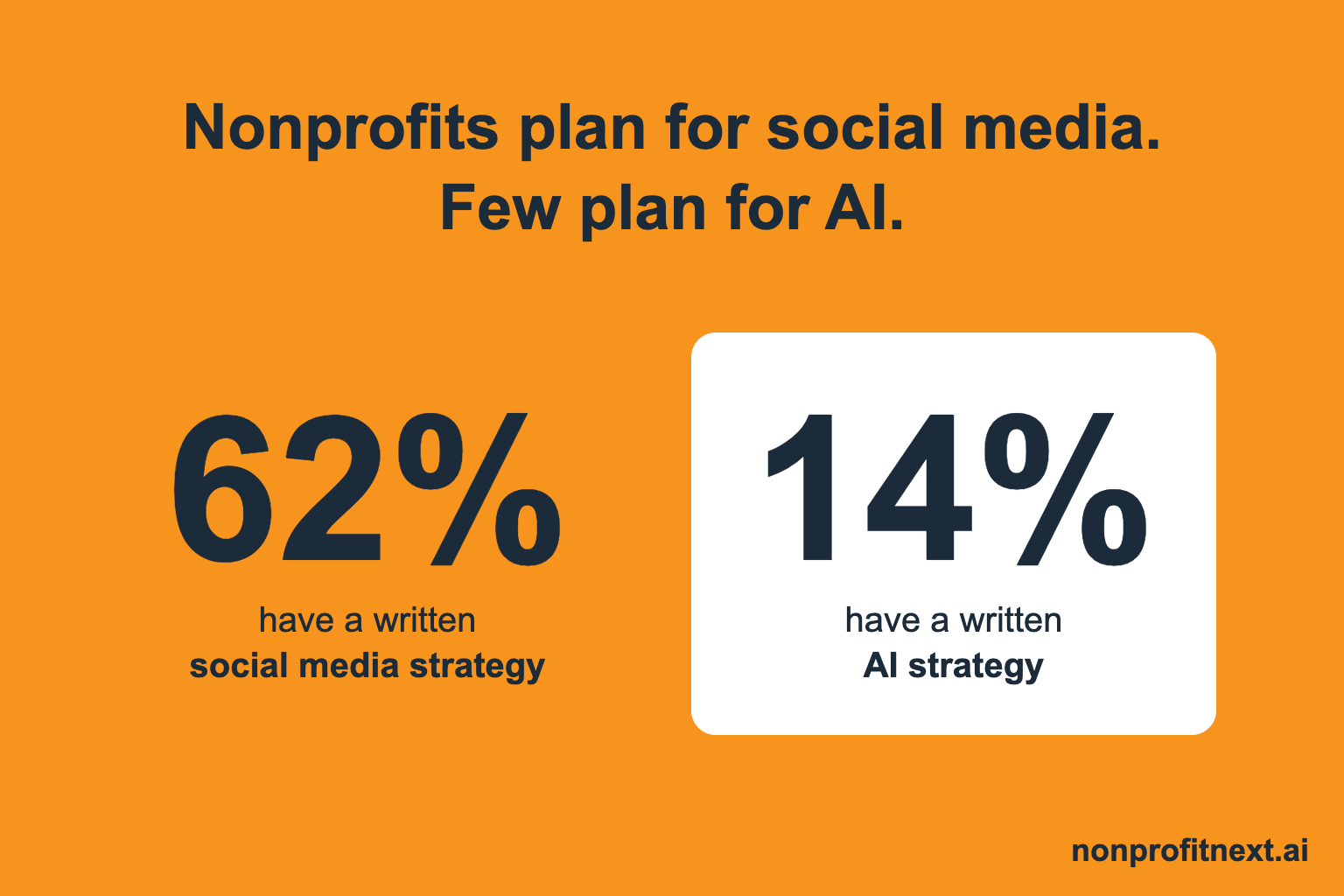
The sector’s own numbers show how uncommon that direction still is. The 2026 Nonprofit Tech for Good Report, based on a June 2026 survey of 826 nonprofit professionals, found that only 14 percent of nonprofits have a written AI strategy. By comparison, 62 percent have a written social media strategy. Nonprofits are more than four times as likely to have a strategy for social media as they are for AI, even though half of nonprofit professionals already use an AI chatbot in their work.
A July 2026 survey of 75 nonprofits by the consulting firm Coastal points in the same direction. Sixty-seven percent of respondents identified a lack of strategic direction as something limiting their AI results, compared with 28 percent who cited budget. The problem for many nonprofits is no longer access to AI tools. It is deciding where those tools belong, how they should be used, and what success should look like.
Five Questions That Turn Your AI Strategy Into Action
Your strategy does not need to answer dozens of questions before you begin. Start with five:
- Do we have a repetitive task that drains real time?
- Is there one person willing to try it?
- Can we keep sensitive data out of it?
- Do staff understand that the goal is help, not replacement?
- Can we give the experiment an afternoon?
If you can answer yes to most of those questions, you are probably ready to choose a first project. If one of the answers is no, that does not mean you need to stop. It simply tells you what to work on next.
1. Do you have a repetitive task that drains real time?
The best first use of AI in a nonprofit is rarely a flashy new capability. It is usually routine work that keeps your people from doing the work only they can do. Think about drafting recurring communications, summarizing information, organizing notes, preparing first drafts of reports, or turning existing material into a different format.
The key is not whether the task is impressive. The key is whether it takes meaningful time and whether AI can make it easier without creating unnecessary risk. If you can name one repetitive task like that, your strategy has a starting point.
2. Is there one person willing to try it?
You do not need the entire organization to be enthusiastic about AI. You need one person to own the first small project: someone willing to test the process, evaluate the results, and say honestly when the tool helps and when it does not.
That person does not need to be your technology expert. Curiosity and credibility with coworkers may matter more. One useful internal example is often more persuasive than ten presentations about what AI might someday do.
3. Can you keep sensitive data out of it?
Your first project should not require unnecessary risks with client, donor, employee, or organizational information. For many tasks, you can work with placeholders or remove identifying information before using an AI tool. Instead of pasting a client’s name and circumstances into a chatbot, for example, you might use terms such as “Client A” or describe the situation without identifiable details.
If a project requires staff to enter sensitive information about the people you serve and you do not yet know how that information will be protected, do not make that your first project. Choose something safer while you work through the policy and technology questions.
4. Do your staff understand that the goal is help, not replacement?
Staff trust matters. If people believe AI is being introduced primarily to eliminate jobs, you should expect resistance, whether that resistance is visible or not.
If instead you are clear that the immediate goal is to reduce repetitive work, improve existing processes, and help people spend more time on higher-value responsibilities, staff are more likely to participate in finding useful applications. That does not mean promising that technology will never change someone’s job. It means being clear about what you are trying to accomplish now and involving employees in decisions that affect their work.
When people believe a tool is coming for their job, they may avoid it or quietly undermine it. When they believe it is coming for some of their busywork, they are much more likely to help you find the next good use.
5. Can you give the experiment an afternoon?
The first experiment requires some real time. Someone needs to define the task, try the tool, review the output, adjust the process, and decide whether the result was actually useful. For a small first project, that may only take a couple of hours.
The point is not to rush through it between meetings. Give the experiment enough attention to learn something useful. If nobody in the organization can find that time this month, do not force the project. Put time on the calendar and start when someone can give it the attention it deserves.
What to Do When You Answer No
A no is not a reason to abandon your AI strategy. It tells you what to work on next.
If no useful task comes to mind, spend a week paying attention to where staff time goes. Look for work that is repetitive, text-heavy, frustrating, or unnecessarily manual. The right first project often becomes obvious once you start looking for it.
If the task you identify involves information about the people you serve and you are unsure how to protect that data, create a basic AI policy first. Our nonprofit AI policy guide shows how to build one in an afternoon.
If staff are worried about what AI means for their jobs, have that conversation before introducing another tool. If nobody has even a couple of hours available, schedule the time for next month and treat it like any other organizational priority.
Your AI strategy does not need to be perfect before you begin. You need enough clarity to try one useful thing safely, learn from it, and decide what comes next.
Turn the Strategy Into a Small First Win
Once you can answer most of the five questions, the next step is not to launch an organization-wide AI initiative. It is to choose one small project. Look for something easy, low-risk, and visible: a repetitive task where AI can produce a useful first draft, save measurable time, or remove an obvious frustration from someone’s workday.
For example, your first project might involve:
- turning meeting notes into a first draft of a summary
- rewriting existing content for a different audience
- creating a first draft of a recurring email
- summarizing a long public document
- organizing brainstorming notes into themes
- creating the first structure for a report based on information you already have
The purpose of the first project is not transformation. It is proof. You want to answer a few basic questions: Did it save time? Was the output good enough to be useful? How much editing did it require? Did the person using it want to use the process again? That is a much better starting point than trying to prove that AI can “transform the organization.”
When staff see AI take a real chore off someone’s plate, the conversation changes. The technology becomes less abstract. People begin to understand where it helps, where it does not, and what they might want to try next.
A successful first project also gives leadership better information. You learn what kind of training staff need. You discover where your policy is unclear. You find out whether the tool fits the workflow. You see how much human review is actually required. Then you can decide what comes next.
Each useful experiment teaches the organization something about its tools, workflows, policies, and people. Over time, those lessons become organizational capacity. That is how a small first win becomes a real AI strategy.
What the Strategy Asks of Each Role
An AI strategy is not one person’s responsibility. The board, leadership, and staff each have different roles, and a people first strategy recognizes all three. Our People First AI guide explores these roles in greater detail.
Your board’s role is asking good questions.
Board members do not need to understand how an AI model works any more than they need to understand the code behind accounting software to provide financial oversight. Their role is governance.
They should be asking questions such as:
- Who is responsible for AI use within the organization?
- What happens to information entered into these tools?
- What are the privacy implications for the people we serve?
- Are staff being consulted and trained?
- How will leadership determine whether AI is actually helping?
The board provides oversight without trying to manage the technology itself.
Leadership’s role is starting with the task, not the tool.
One of the easiest mistakes leaders can make is choosing a product first and figuring out the workflow and people later. Reverse that order. Start with the problem. Identify the task. Talk with the people who actually do the work. Then decide whether AI is useful and which tool fits the need.
Leadership also owns decisions that should not be delegated to individual staff members: where organizational data can go, whether a tool meets privacy or funder requirements, which tools are approved, and how quickly the organization should expand its use. The rollout should move at the pace of your people and your ability to manage the risks, not at the pace of a software company’s product launch.
Your staff’s role is using sanctioned tools instead of improvising.
In many nonprofits, staff are already experimenting with AI before leadership has created a strategy. They may be drafting emails, summarizing documents, brainstorming ideas, or revising reports on their own. Pretending that informal AI use is not happening does not make the organization safer.
A strategy gives staff approved tools, clear boundaries, practical training, and time to learn. In return, staff should bring their experimentation into the open so the organization can learn from what works and address what does not. That turns individual experimentation into organizational knowledge.
Common Questions
Does a small nonprofit really need an AI strategy?
Yes, but the strategy does not need to be complicated. In fact, being small is a reason to keep it simple. On a team of five, every hour saved can matter. A one-page plan and one useful first project may produce results faster than a complex strategy designed for a much larger organization.
What should a nonprofit AI strategy include?
At minimum, it should identify where AI could help over the next year, define one small first project, establish basic rules for protecting sensitive information, and explain to staff what the organization is trying to accomplish. One or two pages may be enough. The value comes from making decisions and acting on them, not from the length of the document.
Do we need a written AI policy too?
Yes, because a policy and a strategy do different jobs. Your AI strategy says where AI should help the organization and what you are trying to accomplish. Your AI policy establishes the boundaries. It identifies approved tools, explains what information should never be entered into them, and tells staff where to go when they are unsure. The policy can be short. Our nonprofit AI policy guide walks through creating one in an afternoon.
How do we know if we are ready to start?
Readiness comes back to the same five questions: Do you have a useful task? Someone willing to own it? A way to protect sensitive information? Honest communication with staff? A little time to experiment? You do not need advanced technical skills or a large budget, and you do not need every answer to be perfect. You need enough clarity to start one useful project safely, learn from it, and use what you learn to shape the next one.
Want a second set of eyes on your AI strategy? I am glad to talk through your organization’s situation with you, without jargon or a sales pitch. You can leave the conversation with a practical first project already identified. Schedule a call with me at calendly.com/larry-nonprofitnext/30min.
Larry is the co-founder and Principal Innovation Strategist at NonprofitNext. Learn more at nonprofitnext.ai.